
What were your expectations about your internship before you joined?
Before commencing my internship at Geosel Consulting, I anticipated the position would largely be office-orientated, emphasising calculations, analysis, and report preparation. I expected that a significant portion of my education would consist of watching skilled engineers and slowly implementing theoretical ideas from university in an organised setting. I anticipated that tasks would be distinctly outlined and directed in a step-by-step manner.
What was the reality? How was it different from your expectations?
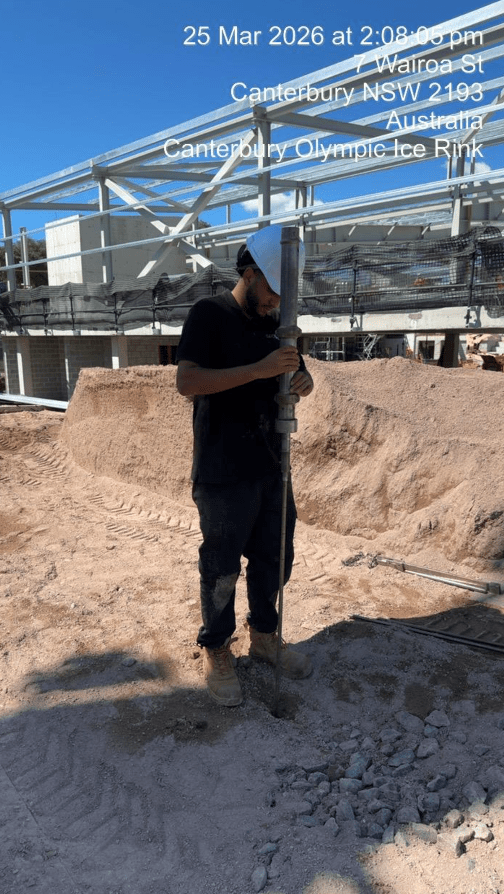
The internship was actually much more active and hands-on than I had anticipated. Field-based tasks like soil sampling, Dynamic Cone Penetrometer (DCP) testing, and site investigations made up a significant amount of the effort. The fast-paced workplace frequently calls for flexibility, initiative, and independent thought. In contrast to what I had anticipated, jobs were not always arranged, and I had to adjust immediately to challenges and shifting site conditions. I learnt from this experience that engineering in practice necessitates flexibility beyond theoretical understanding and incorporates unpredictability.
What lessons were the most important from your internship. Why were they important?
The importance of real-world experience was among the most significant lessons I took away. Even if an undergraduate degree offers a solid theoretical foundation, using this knowledge in practical settings has expanded my understanding of technical principles. Additionally, I discovered how important it is to communicate well in both technical reporting and the field. Effective engineering decision-making requires precise documentation of site circumstances and clear presentation of findings. Additionally, since minor mistakes in data gathering or reporting can have serious repercussions in engineering projects, paying attention to detail was an essential lesson.
After your workplace experience, what would you say your value proposition would be to an
employer? How can you demonstrate this?
My ability to combine theoretical knowledge with real-world, hands-on experience will be my value appeal to a job after this internship. I am able to adapt to real-world issues and contribute successfully in both office and field settings. My expertise performing DCP testing, classifying soil in compliance with AS 1726, and helping to prepare geotechnical reports allow me to illustrate this. In addition, my engineering role and prior work experience have helped me build excellent communication, problem-solving, and organisational skills.
How did your internship influence the type of role in which you are interested?
This internship has strongly influenced my career interests, reinforcing my desire to pursue a role in geotechnical and environmental engineering. It confirmed my interest in practical, field-based engineering work and highlighted the importance of site investigations in the design process.
As a result, I am particularly interested in roles that involve geotechnical analysis, fieldwork, and sustainable infrastructure development.
 Dany Rashwan | Civil & Environmental Engineering Portfolio